As part of Helena's PhD she's been tasked with an investigation into new towns and writing a brief for competition toward creating them.
Although the work was in its early stages the discussions which followed it were interesting
Because I have a distinct interest in sociology topics like new towns and regeneration are particularly appealing to me.
Revelation of the day: the current fashion in housing development is a knee jerk reaction to the modernist Utopian visions of the high density machine like cities. The new ideal has become a detached house with a garden, two cars located in the country with 2.4 children.
P.s If your interested or would like to contribute to her research www.asmallstudio.co.uk is the place to go
Shifting Sands
Other than the fact we got a trip to the seaside the journey to Littlehampton was well worth it. Shifting Sands was an apt conference looking at regeneration of coastal towns fitting in perfectly with the North Sea Faring project.
Speakers included:
- Jim Brathwaite - SEEDA
- John Sorrell - CABE
- David Marks - Marks Barfield
- Thomas Heatherwick
- Wayne Hemmingway - South Coast Design Forum
Because it is impractical to document the entire experience I shall elaborate upon two items that were of real value.
 Firstly the work of Heatherwick and Studio Weave was really exciting because we could see how the work we are undertaking in studio can be directly translated into practice.
Secondly there was a movement away from iconographic design within coastal redevelopment. This I found particularly interesting and was able to forward this question to the panel:
" Taking into account the movement away from iconographic design, what will the main driver of successful coastal regeneration be?"
The panel consisted of
- Barry Shaw - Kent Architecture Centre
- Jane Priestman - Design Champion
- Richard McMann - Bognor Regeneration
- John Kilford - West Sussex Design Commission
- Caroline Lwin - Kent County Council
The question they all answered with a general consensus. Iconographic design is a big gamble often more of a faliure than a success. Coastal towns wanted an enhanced sense of place this is to say that the distinct qualities of the town would be celebrated. Icons of a serrandipitous nature had much greater success because they are born of the town rather than imposed upon it.

Colchester Charette

A good project but too little time. I would have enjoyed an extra few days to complete this. But one does get an idea of the intensity of design required for competitions and quick projects.

Focus week activities
Cityscape: A chance to view work and talk to other professionals in the realm of urban design.
I took the opportunity to talk to a chap from Urbis a specialist lighting company about using lighting in landscape design. I also was able to talk to the Land Restoration Trust who's work has a lot in common with my own designs. They suggested community involvement was essential to successful projects.
National Gallery: Always worth a visit
National Portrait Gallery: It is amazing to walk around a room and know that each face has an amazing story to tell. Does it matter which room it is?
British Museum: To witness objects and art works that are thousands of years old is outstanding in itself each piece or cumulative pieces seeking to tell a story.
If you consider that landscape is a branch of the arts and that art is about the narrative of the senses and the expression in which it is achieved then surely this means that landscape must be born of something. It must express a narrative or be routed in the culture of which it is part. Great landscapes are not superficial they are firmly embedded within context.
I took the opportunity to talk to a chap from Urbis a specialist lighting company about using lighting in landscape design. I also was able to talk to the Land Restoration Trust who's work has a lot in common with my own designs. They suggested community involvement was essential to successful projects.
National Gallery: Always worth a visit
National Portrait Gallery: It is amazing to walk around a room and know that each face has an amazing story to tell. Does it matter which room it is?
British Museum: To witness objects and art works that are thousands of years old is outstanding in itself each piece or cumulative pieces seeking to tell a story.
If you consider that landscape is a branch of the arts and that art is about the narrative of the senses and the expression in which it is achieved then surely this means that landscape must be born of something. It must express a narrative or be routed in the culture of which it is part. Great landscapes are not superficial they are firmly embedded within context.
BTCV
BTCV is a voluntary organisation dedicated to improving the environment.
It's vision: A better environment where people are valued included and involved
It's mission: To create a more sustainable future by improving places and inspiring people
To prevent undercutting to one of the only natural stretches of the Thames between Richmond and Kew we set about styling the river bank which is a cheap traditional way to prevent erosion
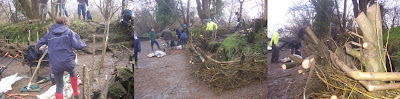
Willow steaks set in the ground are woven around using smaller branches creating a small wall around the riverbank which retains the silt the river deposits when high. The willow stakes can take root due to the voracious nature of the plant which when coupled with the retaining wall all adds to protect against erosion
It's vision: A better environment where people are valued included and involved
It's mission: To create a more sustainable future by improving places and inspiring people
To prevent undercutting to one of the only natural stretches of the Thames between Richmond and Kew we set about styling the river bank which is a cheap traditional way to prevent erosion
Willow steaks set in the ground are woven around using smaller branches creating a small wall around the riverbank which retains the silt the river deposits when high. The willow stakes can take root due to the voracious nature of the plant which when coupled with the retaining wall all adds to protect against erosion
Subscribe to:
Posts (Atom)


